The Truth About Anti-Aging Actives: What Work and What’s Just Marketing
Walk into any pharmacy or beauty retailer and the shelves look like a science fair — serums promising “clinically proven” results, creams boasting “biopeptide complexes,” and moisturizers claiming to work at the “cellular level.” Some of these products do deliver. Many do not.
The issue is not that topical anti-aging is ineffective. A handful of ingredients have compelling, independent clinical evidence behind them. The issue is that the market rewards confident marketing more than rigorous science, and most consumers have no easy way to tell the difference. This article gives you that framework: a three-tier evidence system that separates what is actually proven from what sounds convincing on a label.
What You’ll Learn:
- Why “clinically proven” on packaging means almost nothing and what to look for instead
- Which ingredients have strong evidence, which are worth trying, and which are mostly hype
- The science behind each active ingredient, explained without the jargon
- How your topical routine fits alongside devices and other anti-aging approaches
The Label Problem
Here is something most skincare brands do not advertise: in most markets, skincare is regulated as a cosmetic, not a drug.
- Drugs (like prescription tretinoin) must prove efficacy through independent clinical trials before they can be sold. The evidence bar is high.
- Cosmetics (everything else on the skincare shelf) only need to be safe. They are not required to prove they do what they claim.
This means terms like “clinically proven,” “dermatologist tested,” and “visibly reduces wrinkles in 4 weeks” are marketing language, not regulatory designations. The studies behind them, if they exist at all, are often short, small, and funded by the brand selling the product.
None of this means all OTC anti-aging ingredients are useless. Some have impressive independent evidence. But it does mean you need to evaluate ingredients on their own merits, not on the confidence of the packaging.
Tier 1 — The Evidence-Backed Core
These ingredients have multi-study, independently replicated data, including randomized controlled trials and, in some cases, biopsy-confirmed changes in actual skin tissue. This is the gold standard.
Retinoids: The Overachiever of Skincare
Retinoids are vitamin A derivatives, and they are the closest thing skincare has to a proven anti-aging workhorse. Here is what they do:
- Speed up cell turnover — your skin sheds and renews itself faster, reducing dullness and smoothing texture
- Tell fibroblasts to make more collagen — specifically type I procollagen, the structural protein that keeps skin firm
- Block enzymes that break down existing collagen — essentially protecting the collagen you already have
Prescription tretinoin has the strongest evidence, with decades of randomized controlled trial data and biopsy confirmation of new collagen. OTC retinol needs to be converted by the skin before it becomes active, which makes it gentler but less potent. (Read more about retinoids here.)
SPF: The One That Truly Prevents Aging
Sunscreen is the most important anti-aging ingredient in any routine. Not because it reverses aging, but because it prevents it. UV exposure accounts for the vast majority of visible facial aging. SPF does not reverse existing damage, but nothing else you apply will work as well if you are not also blocking the source.
- Use broad-spectrum SPF 30+ daily
- Apply rain or shine — UV damage accumulates even on overcast days and through windows
- Reapply if outdoors for extended periods
Vitamin C: Your Skin’s Morning Bodyguard
Vitamin C (L-ascorbic acid) is an antioxidant. Think of it as a shield your skin cells deploy against the environmental damage that accumulates every day from UV, pollution, and other oxidative stressors. But it does more than protect:
- Neutralizes free radicals that break down collagen
- Acts as a co-factor in collagen synthesis — your body cannot build collagen without it
- Brightens skin and reduces pigmentation over time
However, vitamin C oxidizes quickly. Look for stabilized L-ascorbic acid at 10–20% in opaque, airtight packaging. A brown, separated formula has lost most of its potency.
Niacinamide: The Quiet Achiever
Niacinamide (vitamin B3) does not get the same cultural moment as retinol or vitamin C, but its clinical track record is arguably the most consistent of any OTC active:
- A study using 5% niacinamide showed significant reductions in fine lines, hyperpigmented spots, and red blotchiness at 12 weeks
- A separate research confirmed significant wrinkle reduction at 8 weeks using 4% niacinamide
- Recent research suggests niacinamide may help suppress the inflammatory output of senescent “zombie cells” in skin tissue — a newly identified mechanism that links it to biological aging at a deeper level
- It is exceptionally well tolerated and rarely causes irritation
If you could only add one new ingredient to a basic routine, niacinamide makes a strong case.
Tier 2 — Worth Including, With Realistic Expectations
These ingredients have legitimate biological mechanisms and some clinical support. The evidence is less consistent than Tier 1, but they make meaningful additions to a well-built routine.
Peptides: The Signalling System
Peptides are short chains of amino acids that act like text messages to your skin cells — specifically, they signal fibroblasts to increase collagen production. The concept is well-founded, and several studies confirm improvements in skin elasticity and wrinkle depth with specific peptide formulations.
The complication: “peptides” covers hundreds of different molecular sequences, and their evidence varies enormously. Well-studied examples like palmitoyl pentapeptide-4 (often listed as Matrixyl) have more robust backing than many others.
Topical Hyaluronic Acid: Great Hydrator, Limited Structural Role
Hyaluronic acid (HA) is a molecule your skin naturally produces to hold water. One molecule can hold up to 1,000 times its weight in moisture. Topically, it is an excellent humectant:
- Draws water to the skin surface, plumping fine lines temporarily
- Improves skin capacitance and surface hydration in multiple clinical trials
- Well tolerated by virtually all skin types
The important nuance: topical HA is not the same as injectable HA filler. Larger HA molecules sit on the surface; smaller ones can reach the epidermis but not the deep dermis where structural volume loss occurs. Products marketing topical HA as a “non-injectable alternative” for volume restoration are significantly overstating.
AHAs (Alpha Hydroxy Acids)
Glycolic acid, lactic acid, and their cousins work by loosening the bonds between dead skin cells at the surface, speeding up exfoliation and revealing fresher skin underneath. Their strengths:
- Consistently improve texture, brightness, and the appearance of fine lines
- Reduce the look of pigmentation over time
- Well supported for surface-level improvements in multiple studies
AHAs increase photosensitivity, making daily SPF crucial when they are in your routine.
Tier 3 — The Marketing-Heavy Zone
A significant slice of the anti-aging cream market sits here: ingredients or claims that sound compelling but lack independent, peer-reviewed substantiation.
Common culprits:
- “Plant stem cell” extracts — the mechanism sounds impressive, but plant stem cells cannot directly instruct human skin cells, and the published evidence is thin
- Exotic botanical blends — often included at concentrations too low to have any measurable effect
- Proprietary “complex” names — if you cannot find the ingredient in published dermatology literature under any name, that is a signal
- Before-and-after galleries without methodology — lighting, camera angle, makeup, and skin hydration on photo day can produce dramatic-looking “results” with no active ingredient involved
Red flags to watch for on packaging:
- “Clinically proven” with no citation or named study
- Results attributed to a multi-ingredient formula (impossible to know what is doing the work)
- A high price point justified almost entirely by a single exotic or proprietary ingredient
To be clear: this is not a blanket dismissal of premium skincare. Some expensive products contain high concentrations of Tier 1 actives in well-stabilized delivery systems, which has real value. The problem arises when the marketing centers on a Tier 3 ingredient while the actual anti-aging work is being done by a small percentage of retinol buried in the formula.
Evidence at a Glance
| Tier | Ingredients | Evidence Base | What to Expect |
|---|---|---|---|
| Strong | Retinoids, SPF, vitamin C, niacinamide | Multiple independent RCTs; biopsy-confirmed changes | Measurable collagen, cell turnover, pigmentation, UV protection |
| Moderate | Peptides, topical HA, AHAs, growth factors | Promising; variable trial quality | Hydration, surface renewal, signalling support |
| Weak/Marketing | Exotic botanicals, “stem cell” extracts, proprietary blends | Largely brand-funded or absent | Unclear or marginal at best |
Where Creams Fit in the Bigger Picture
Creams are the always-on foundation layer of any anti-aging routine — daily, low-effort, cumulative. But they have limits, and knowing those limits is just as important as knowing what they can do.
- Topical creams handle surface and dermal renewal — cell turnover, antioxidant defence, collagen signalling, barrier support
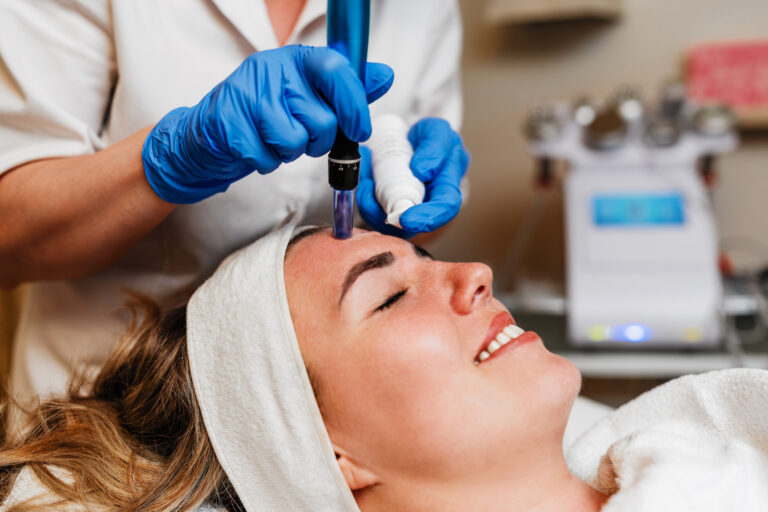
- At-home devices (RF, microcurrent, red light, microneedling) add periodic physical energy-based stimulation that ingredients cannot replicate
- Injectables (Botox, fillers) address what neither creams nor devices can fully correct — muscle-driven wrinkles and volume loss at structural depth
A strong Tier 1 topical routine is the first layer to get right. The incremental benefits of devices and injectables are maximized when applied on top of a solid foundation, not as a substitute for one.
Conclusion
Building an effective topical routine is simpler than the skincare aisle suggests: anchor it in Tier 1 actives, add Tier 2 selectively, and treat Tier 3 claims with proportionate skepticism. The best anti-aging cream is not the most expensive one. It is the one with the right actives, at the right concentrations, used consistently.
References
- “Double-blind, Half-face Study Comparing Topical Vitamin C and Vehicle for Rejuvenation of Photodamage.”https://pubmed.ncbi.nlm.nih.gov/11896774/
- “Topical Vitamin C and the Skin: Mechanisms of Action and Clinical Applications.” https://pmc.ncbi.nlm.nih.gov/articles/PMC5605218/
- “Niacinamide: A B Vitamin that Improves Aging Facial Skin Appearance.” https://pubmed.ncbi.nlm.nih.gov/16029679/
- “The Clinical Anti-Aging Effects of Topical Kinetin and Niacinamide in Asians: A Randomized, Double-Blind, Placebo-Controlled, Split-Face Comparative Trial.” https://onlinelibrary.wiley.com/doi/abs/10.1111/j.1473-2165.2007.00342.x
- “Benefits of Topical Hyaluronic Acid for Skin Quality and Signs of Aging.” https://pmc.ncbi.nlm.nih.gov/articles/PMC10078143/
- “Anti-Wrinkle Benefits of Peptides Complex Stimulating Skin Extracellular Matrix.”https://pmc.ncbi.nlm.nih.gov/articles/PMC6981886/