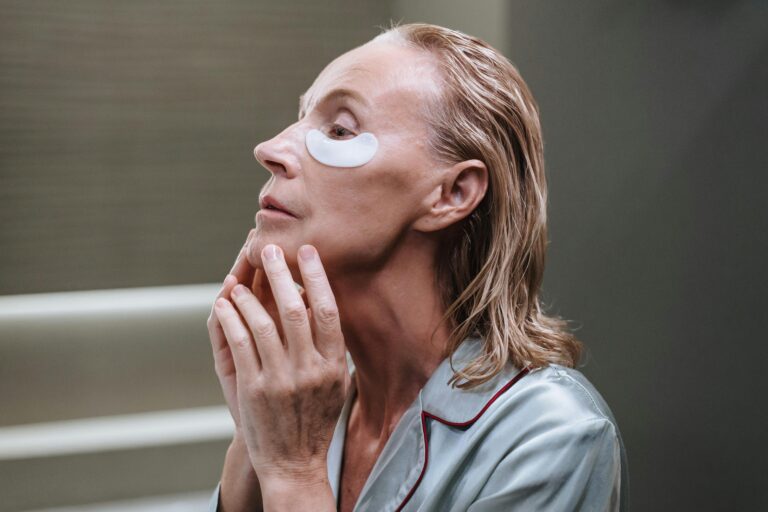
You can optimize your skincare routine to perfection — the right serums, daily SPF, consistent retinoids. But if you are chronically sleep-deprived and constantly stressed, your skin cells are working against you at a biological level no topical product can fully overcome.
Sleep and stress are two of the most underestimated drivers of premature skin aging. The mechanisms are well-documented, measurable, and largely within your control. This article explains exactly what poor sleep and chronic stress do to your skin, and the practical daily fixes that science supports.
What You’ll Learn:
- How sleep deprivation damages skin at the cellular level
- Why cortisol is one of collagen’s biggest enemies
- Evidence-backed sleep and stress fixes with real skin benefits
- How to structure your evening routine for maximum anti-aging effect
What Happens to Your Skin While You Sleep
Sleep is not passive downtime — it is your body’s most active repair window. During deep sleep, the pituitary gland releases human growth hormone (HGH), which drives fibroblast activity and collagen synthesis in the skin. Cortisol — the body’s stress hormone — simultaneously drops to its lowest daily levels, allowing collagen production to proceed without interference.
Disrupt this window consistently, and you disrupt the entire repair cycle.
What Sleep Deprivation Does to Skin
The link between poor sleep and accelerated skin aging has been measured directly. A landmark University Hospitals Cleveland study found that poor sleepers showed significantly more fine lines, uneven pigmentation, and reduced skin elasticity compared to good sleepers of the same age. Poor sleepers also recovered from UV damage 30% more slowly — meaning their skin was measurably less able to repair environmental stress.
A 2025 study added another dimension: sleep quality directly enhanced the effectiveness of oral collagen supplementation. Participants with better sleep showed significantly greater improvements in skin hydration and elasticity than poor sleepers taking the exact same supplement. Even the supplements you take work harder when your sleep is consistent.

How Cortisol Destroys Collagen
Cortisol is essential for short-term stress response — but chronically elevated levels are deeply damaging to skin. It activates matrix metalloproteinases (MMPs), the same enzymes triggered by UV radiation that break down existing collagen and elastin fibers. At the same time, it suppresses fibroblast activity, slowing new collagen synthesis. Collagen is being destroyed faster while simultaneously being replaced more slowly.
Chronic stress also drives systemic inflammation — a persistent low-grade inflammatory state that interferes with the skin’s repair mechanisms and degrades the extracellular matrix, the structural framework that keeps skin firm.
Simple Daily Fixes: Sleep
1. Keep a Consistent Sleep and Wake Time
The body’s circadian rhythm regulates the timing of HGH release and cortisol suppression. Inconsistent sleep schedules disrupt this rhythm even when total hours are adequate. Going to bed and waking at the same time daily — including weekends — anchors your circadian clock and maximizes deep, restorative sleep stages.
2. Go Screen-Free 30–60 Minutes Before Bed
Blue light from phones and laptops suppresses melatonin production by up to 50% for several hours after exposure. Replace screens with low-light activities: reading, light stretching, journaling, or your skincare routine.
3. Keep Your Bedroom Cool and Dark
A bedroom temperature of 65–68°F (18–20°C) is consistently associated with better sleep quality in research. Complete darkness supports melatonin production — use blackout curtains or a sleep mask.
4. Apply Your Actives Before Bed
Skin is most receptive to active ingredients at night. Retinoids, peptides, and overnight repair creams all work in alignment with the skin’s nocturnal repair cycle — apply them immediately before sleep to maximize efficacy.
5. Switch to a Silk or Satin Pillowcase
Cotton creates friction against skin during movement, contributing to sleep lines over time. Silk and satin reduce friction and absorb less product — meaning your overnight actives stay on your skin, not your pillow.
Simple Daily Fixes: Stress
6. 10 Minutes of Daily Mindfulness or Meditation
A meta-analysis of 45 studies found that mindfulness-based interventions significantly reduced cortisol and biological stress markers. Ten focused minutes daily is enough to shift the cortisol baseline meaningfully over weeks and months.
7. Exercise Regularly
Moderate exercise initially raises cortisol acutely, then drives it below baseline during recovery — effectively lowering chronic cortisol with regular training. Thirty minutes of moderate exercise most days is both a cortisol regulator and a direct fibroblast stimulator.
8. Cut Caffeine After 1pm
Caffeine’s half-life is 5–7 hours — a 3pm coffee still has half its stimulant effect by 8–10pm. Afternoon caffeine delays sleep onset, reduces deep sleep, and elevates cortisol before bed. Shifting all caffeine to the morning has a compounding positive effect on both sleep quality and stress biology.
9. Build a Consistent Evening Ritual
The nervous system responds to routine. A simple, repeatable evening ritual — warm shower, skincare, 10 minutes of reading — signals to the brain that the day is over, initiating a shift from fight-or-flight to rest-and-repair mode. This parasympathetic shift reduces cortisol and deepens sleep quality.
Your Evening Anti-Aging Routine at a Glance
| Time | Action | Why It Matters |
|---|---|---|
| By 1:00pm | Last caffeine | Protects deep sleep stages |
| 9:00pm | Screens off | Preserves melatonin production |
| 9:00–9:30pm | Wind-down ritual | Shifts nervous system to repair mode |
| 9:30pm | Skincare (retinoid, peptides, moisturizer) | Aligns actives with nocturnal repair cycle |
| 10:00pm | Bedroom cool (65–68°F) and dark | Optimizes sleep onset and depth |
| 10:00pm–6:00am | 7–9 hours sleep | HGH release, cortisol suppression, collagen synthesis |
Conclusion
Sleep and stress are not secondary lifestyle factors — they are primary biological drivers of how fast your skin ages. Cortisol degrades collagen, inflammation disrupts repair, and sleep deprivation compounds both. But each mechanism is modifiable with habits that cost nothing and are available to everyone.
The fixes here are not complicated. They are consistent. And in anti-aging, consistency over months always outperforms intensity in bursts.
References
- Oyetakin-White, P., et al. (2015). “Does Poor Sleep Quality Affect Skin Ageing?” Clinical and Experimental Dermatology. https://pubmed.ncbi.nlm.nih.gov/25266053/
- Akitomo, Y., et al. (2025). “Can Good Sleep Quality Enhance the Benefits of Oral Collagen Supplementation on Skin Properties?” Journal of Cosmetic Dermatology. https://pubmed.ncbi.nlm.nih.gov/39912934/
- Baumann, L. (2007). “Skin Aging and Its Treatment.” Journal of Pathology. https://pubmed.ncbi.nlm.nih.gov/17200939/
- Chen, Y., & Lyga, J. (2014). “Brain-Skin Connection: Stress, Inflammation and Skin Aging.” Inflammation & Allergy Drug Targets. https://pubmed.ncbi.nlm.nih.gov/24780442/
- Walker, M. (2017). Why We Sleep: Unlocking the Power of Sleep and Dreams. Scribner, New York. ISBN: 978-1501144318.
- Chang, A.M., et al. (2015). “Evening Use of Light-Emitting eReaders Negatively Affects Sleep.” PNAS. https://pubmed.ncbi.nlm.nih.gov/25535358/
- Pascoe, M.C., et al. (2017). “Mindfulness Mediates the Physiological Markers of Stress.” Neuroscience & Biobehavioral Reviews. https://pubmed.ncbi.nlm.nih.gov/28863392/
- Zschucke, E., et al. (2015). “The Stress-Buffering Effect of Acute Exercise: Evidence for HPA Axis Negative Feedback.” Psychoneuroendocrinology. https://pubmed.ncbi.nlm.nih.gov/25462913/
- Drake, C., et al. (2013). “Caffeine Effects on Sleep Taken 0, 3, or 6 Hours Before Going to Bed.” Journal of Clinical Sleep Medicine. https://pubmed.ncbi.nlm.nih.gov/24235903/