HIFU Facial Treatment: Non-Surgical Lifting Science Explained
Of all the non-surgical anti-aging treatments available today, HIFU stands apart for one specific reason: it reaches a tissue layer no other non-surgical technology can reliably access. That depth is what makes it genuinely different from the RF, microcurrent, and red light treatments. Whether you’re researching it for the first time or getting ready to book a session, here’s everything you need to know.
What You’ll Learn:
- What HIFU is and why it’s different from every other non-surgical option
- The SMAS layer and why depth matters for real lifting
- What happens beneath the skin during and after a session
- What clinical studies show about results and timelines
- How it compares to RF, microcurrent, and fractional laser
- Who is and isn’t a good candidate
Not The Typical Skin Treatment
HIFU stands for High-Intensity Focused Ultrasound. It uses sound energy to create precise thermal activity deep within the skin’s tissue layers. Unlike red light therapy (which uses light) or RF (which uses heat from electromagnetic waves), HIFU works by focusing ultrasound waves to a precise focal point beneath the skin surface, similar to how a magnifying glass focuses sunlight to a single point.
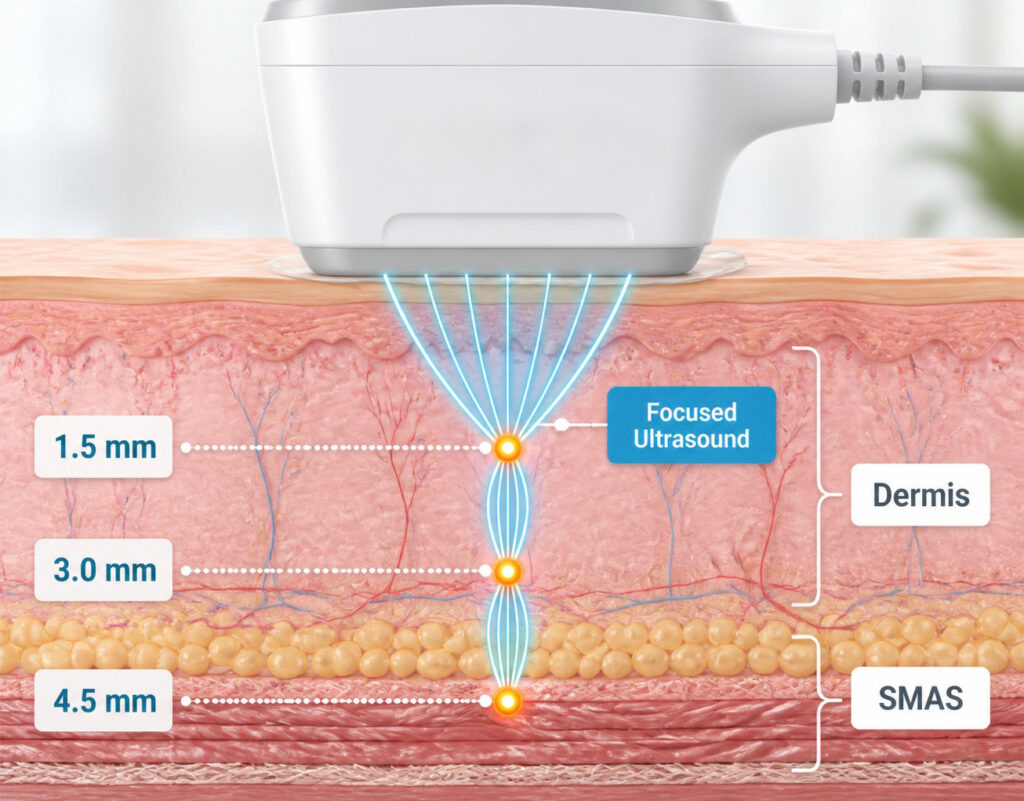
The technology was originally developed for medical applications including cancer treatment, and was later adapted for aesthetic use. Today, the most widely recognized clinical systems include Ultherapy, Sofwave, and Ultraformer III. Each delivers HIFU energy at calibrated depths targeting different layers of the skin simultaneously: 1.5mm, 3mm, and 4.5mm.
The SMAS Layer: Why This Changes Everything
The 4.5mm depth is where HIFU’s real advantage lies. At that level, the ultrasound energy reaches a structure called the SMAS — the Superficial Musculoaponeurotic System. In plain terms, the SMAS is a fibromuscular layer that sits beneath the dermis and acts as a structural scaffold for the face.
Here’s why that matters: the SMAS is the exact layer that surgeons tighten during a surgical facelift. No other non-surgical technology reliably reaches it. RF devices heat the dermis. Red light therapy stimulates fibroblasts. Microcurrent tones facial muscles. HIFU goes deeper than all of them, targeting the foundational layer responsible for the structural position of the cheeks, jawline, and neck.
When this layer is tightened, the overlying skin lifts with it. That’s what separates HIFU from surface-level treatments.
What’s Actually Happening Under the Skin
During a HIFU session, the device delivers focused ultrasound energy that creates microscopic thermal coagulation points at each target depth. The surrounding tissue is left completely intact — the energy bypasses the skin surface and concentrates precisely where it’s directed.
These coagulation points trigger the body’s wound-healing response:
- Heat shock proteins (HSPs) are activated, signaling the tissue to begin repair
- Fibroblasts ramp up collagen and elastin production in the treated areas
- Existing collagen fibers contract immediately, producing a subtle tightening effect right after treatment
- New collagen matrix is laid down over the following months, progressively improving structure and firmness
This is why HIFU results don’t peak immediately after a session. The initial tightening is real, but the full effect of new collagen remodeling takes 3 to 6 months to complete. Most patients see continued improvement for up to 6 months post-treatment, with results lasting anywhere from 12 to 18 months.
What the Studies Show
The clinical evidence for HIFU is substantial. Here’s what the research consistently demonstrates:
Lifting and tightening:
- Skin laxity improvements of 18% to 30% have been documented across multiple clinical trials, particularly in the lower face, neck, and periorbital regions
- A brow lift study of 30 participants found an average lifting effect of 1.56mm at 90 days, with 90% reporting significant improvement
- A clinical study assessing skin laxity found an average improvement rating of 58% by doctors and 60% by patients at the three-month mark
Patient satisfaction:
- A systematic review of 45 clinical trials found a favorable safety profile with fewer than 5% of patients reporting transient side effects (mild redness, slight swelling, temporary discomfort)
- A separate systematic review of 16 studies found 92% of patients reported improvement in skin tightening and wrinkle reduction lasting up to one year
- Satisfaction rates across multiple studies consistently exceed 80%
Honest concerns:
- Results vary meaningfully based on age, starting degree of skin laxity, and individual collagen response
- Those with significant sagging may need more than one session for meaningful improvement
- HIFU is not a replacement for surgical correction in cases of severe skin laxity
How HIFU Fits With Other Treatments
HIFU works on the deepest structural layer. The other technologies covered in this series work at different depths and through different mechanisms. Used together, they address aging from multiple angles:
| Technology | Depth Reached | Primary Benefit | Downtime |
|---|---|---|---|
| HIFU | 1.5mm, 3mm, 4.5mm (SMAS) | Deep structural lifting | Minimal |
| RF | Dermis (1–3mm) | Collagen tightening, wrinkle reduction | None |
| Microcurrent | Facial muscles | Tone, contour, facial lift | None |
| Fractional Laser | Epidermis + upper dermis | Texture, tone, resurfacing | 1–7 days |
A common and well-supported clinical approach is to use HIFU for structural lifting as a foundation, then maintain and complement results with regular RF or microcurrent sessions in between. Research also shows that combining HIFU with RF in a single treatment plan synergistically improves skin elasticity, pore reduction, and wrinkle depth beyond what either technology achieves alone.
Is HIFU the Right Treatment for You?
HIFU works best for a specific profile. The clearest candidates are:
- Adults in their 30s to 50s with mild to moderate skin laxity
- People with good baseline skin quality who want to lift and tighten rather than resurface
- Those looking for a long-lasting result from periodic clinic sessions rather than a daily home routine
It is less suitable for:
- Significant or advanced sagging where surgical correction would produce better outcomes
- Very thin or fragile skin with poor collagen reserves
- Anyone with metal implants, a pacemaker, or implanted electrical devices in or near the treatment area
- Pregnant women, those with active skin infections, or those with open wounds in the treatment area
One important note: always consult a qualified practitioner before booking. A proper in-person assessment of your skin laxity, tissue depth, and suitability is essential for safe and effective HIFU treatment. Results vary significantly depending on the operator’s skill and device calibration, so choosing an experienced, reputable clinic matters as much as the technology itself.
Conclusion
HIFU occupies a genuinely unique position in the non-surgical anti-aging toolkit. No other non-invasive treatment reaches the SMAS layer, and for patients with mild to moderate laxity, the clinical results are among the most significant available without surgery. It works best not as a standalone solution but as a structural foundation, complemented by consistent skincare and other treatments like RF, microcurrent, or red light therapy between sessions.
References
- “A Systematic Review of High-Intensity Focused Ultrasound in Skin Tightening.” https://pubmed.ncbi.nlm.nih.gov/40184185/
- “Ultraformer III Clinical Studies.” https://ultraformer.com/for-physicians/clinical-studies/
- “Safety and Efficacy of High-Intensity Focused Ultrasound for Periorbital, Perioral, and Neck Wrinkles.” https://pubmed.ncbi.nlm.nih.gov/35249260/
- “Systematic Review and Meta-Analysis of Safety and Efficacy of HIFU for Face and Neck Rejuvenation.” https://pubmed.ncbi.nlm.nih.gov/32026164/
- “Efficacy of Radiofrequency Combined With Single-Dot Ultrasound for Skin Rejuvenation: A Split-Face Trial.” https://onlinelibrary.wiley.com/doi/10.1111/srt.13452
- “Do Different HIFU Frequencies Induce Significant Histological and Clinical Improvements?” https://pubmed.ncbi.nlm.nih.gov/39973106/