Radio Frequency for Skin Tightening: How It Rebuilds Collagen and Lifts Sagging Skin
Of all the at-home anti-aging technologies available right now, radiofrequency (RF) has arguably the deepest and most consistent clinical track record. It’s been used in professional dermatology clinics for over two decades — and the at-home versions that have emerged in recent years are backed by a growing body of solid clinical evidence.
If you’ve been curious about RF but weren’t sure how it actually works, or whether it’s worth the investment — this is the breakdown you need.
What You’ll Learn:
- What radiofrequency energy is and why heat is the key mechanism
- Exactly how RF triggers collagen rebuilding in the dermis
- What clinical studies actually show about results and timelines
- How to use an at-home RF device correctly
- Who should and shouldn’t use RF
What Is Radiofrequency Energy?
Radiofrequency is a form of electromagnetic energy. It’s the same broad category as the radio waves in your phone signal, just used in a very different way. When applied to skin, RF energy penetrates through the outer layers and converts to heat in the dermis — the deeper structural layer where collagen lives.
The key here is precision. RF doesn’t burn the surface. It selectively heats the dermis to a therapeutic temperature, typically between 40–45°C (104–113°F), while leaving the outer skin intact. That controlled, targeted heat is what sets it apart from most other at-home skin tools.
How RF Rebuilds Collagen
RF triggers collagen rebuilding through two sequential phases:
Phase 1: Immediate Collagen Contraction
When collagen fibers are heated to the right temperature, they contract and tighten immediately. This is why many people notice a temporary firming effect right after a session — the existing collagen has literally been tightened by heat.
Phase 2: Long-Term Collagen Remodeling
The more significant and lasting mechanism kicks in after the session. The controlled heat creates a mild thermal injury, just enough to trigger the skin’s wound-healing response without causing visible damage to the surface. This sets off a cascade of biological activity:
- Heat shock proteins are activated, signaling the skin to upregulate collagen gene expression
- Fibroblasts are stimulated to produce new collagen and elastin
- MMP enzyme activity drops, meaning existing collagen is being broken down more slowly
- Dermal thickness increases as new collagen matrix is laid down over weeks
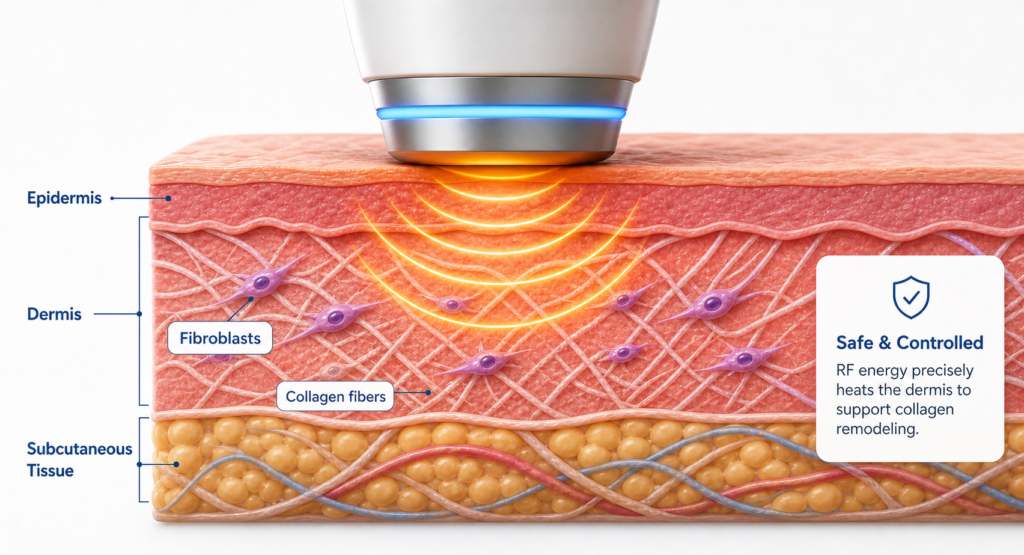
RF doesn’t just tighten what’s there, it prompts the skin to build new structural support from scratch.
What the Research Shows
The clinical evidence behind RF is one of the strongest in the at-home device category. Here’s what the studies show:
Wrinkle reduction and skin texture:
- A trial of 33 women aged 35–60 found statistically significant improvements in wrinkles, skin radiance, color, and thickness on the RF-treated side compared to the skincare-only control side. Results appeared as early as week 2 and continued improving through week 12.
- An 8-week home device clinical trial found significant improvement in wrinkle scores at both the 4-week and 8-week marks, with ultrasound measurements confirming a measurable increase in dermal thickness.
- A home-use TriPollar RF device trial found periorbital (around the eyes) wrinkle reduction of 41% in 95% of participants after 6 weeks, with all participants reporting satisfaction.
Timeline:
- Early changes: weeks 2–4
- Significant collagen remodeling: 8–12 weeks
- Continued improvement possible up to 6 months after a consistent treatment course
RF vs. Microcurrent: What’s the Difference?
Since we previously covered microcurrent, it’s worth understanding how these two technologies compare:
| RF | Microcurrent | |
|---|---|---|
| Mechanism | Thermal heat → collagen rebuilding | Electrical current → muscle toning + ATP boost |
| Works on | Dermis (collagen and elastin) | Facial muscles + fibroblasts |
| Primary benefit | Skin tightening, collagen density | Facial contouring, muscle lift |
| Results timeline | 8–12 weeks for full effect | 4–8 weeks for noticeable lift |
| Best for | Skin laxity, wrinkle depth, texture | Jawline definition, facial tone |
They work differently and complement each other well, which is why combining them (in separate sessions) is a popular advanced approach. We’ll cover device stacking in later blogs.
What RF Can and Can’t Do
What it can do:
- Tighten mildly to moderately lax skin around the jawline, cheeks, and eyes
- Measurably reduce fine-to-moderate wrinkle depth
- Increase dermal thickness and collagen density with consistent use
- Improve overall skin texture, radiance, and firmness
- Deliver results that outperform skincare products alone
What it can’t do:
- Replace surgical options for severe skin laxity or significant jowling
- Produce overnight results — collagen remodeling takes weeks
- Work without consistency — sporadic use won’t produce meaningful collagen accumulation
- Treat very deep structural changes that require more invasive intervention
Is RF Worth It?
The evidence says yes. RF stands out because it addresses the root cause of skin laxity: declining collagen in the dermis. While topical ingredients like retinoids and peptides work at the surface and upper dermal levels, RF delivers energy directly to the structural layer where collagen is produced and maintained.
Consistent at-home RF use, combined with strong daily skincare habits, is one of the most clinically validated non-invasive strategies available for skin tightening. It won’t replicate a surgical facelift, but for mild to moderate laxity, it delivers real, measurable, and increasingly well-documented results.
References
- “Radiofrequency-Induced Thermal Modulation Reduces Senescence-Induced Collagen Fiber Degradation in Facial Ligaments.” https://pmc.ncbi.nlm.nih.gov/articles/PMC12651331/
- “Effectiveness of a Radiofrequency Device for Rejuvenation of Aged Skin at Home: A Randomized Split-Face Clinical Trial.” https://doi.org/10.1007/s13555-022-00697-y
- “Home-use TriPollar RF Device for Facial Skin Tightening: Clinical Study Results.” https://pubmed.ncbi.nlm.nih.gov/21401380/
- “Efficacy and Safety of a Noninvasive, Home-Based Radiofrequency Device for Facial Rejuvenation.” https://onlinelibrary.wiley.com/doi/10.1111/jocd.16076
- “Radiofrequency Treatment Attenuates Age-Related Changes in Dermal-Epidermal Junctions of Animal Skin.” https://pmc.ncbi.nlm.nih.gov/articles/PMC11120932/