How Microcurrent Devices Lift and Tone Your Face — The Science
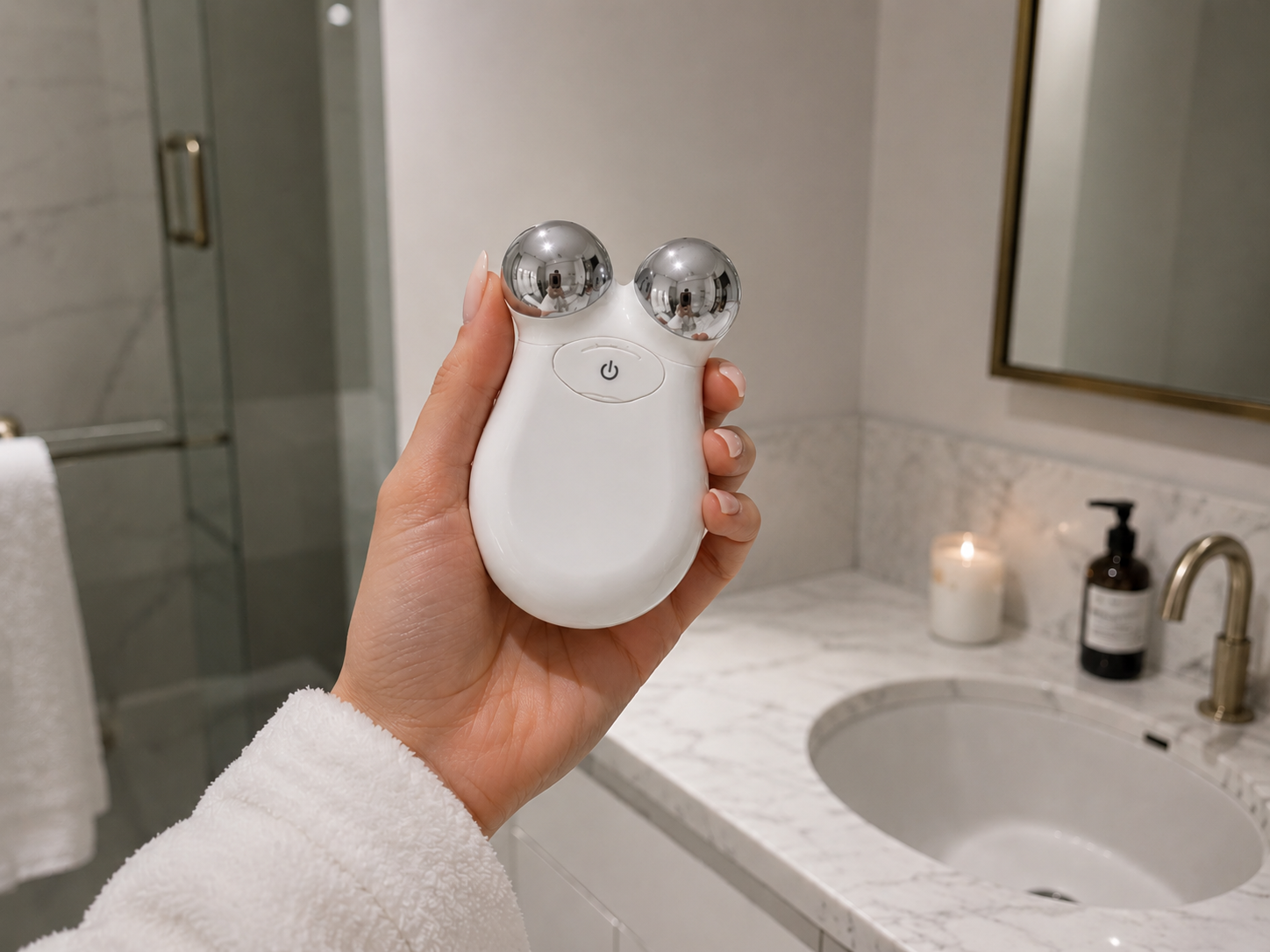
If you’ve ever seen someone glide a Y-shaped wand across their face and thought “does that actually do anything?” — you’re not alone. Microcurrent facial devices have gone from spa-only treatments to bathroom shelf staples, with claims ranging from “instant facelift” to “facial gym session.”
But what’s actually happening beneath the skin when you use one? The short answer: quite a lot — if you use it consistently and understand what it can realistically do. Here’s the science, plain and simple.
What You’ll Learn:
- What microcurrent is and how it interacts with your skin and muscles
- The cellular mechanisms that make it an effective anti-aging tool
- What results are realistic — and on what timeline
- How to use a microcurrent device correctly
- Who should and shouldn’t use one
What Is Microcurrent, Exactly?
Microcurrent therapy delivers very low-level electrical currents, typically between 10 and 600 microamperes (μA), to the skin and the muscles underneath. To put that in perspective, one microampere is one-millionth of an ampere. These currents are so gentle they operate below the sensory threshold, meaning most people feel little to nothing during a session.
Here’s why that matters for skin aging: your body already runs on electricity. Every cell maintains an electrical charge, and biological processes — collagen production, muscle contraction, cellular repair — are all driven by electrical signals. Microcurrent mimics these natural bioelectric signals, giving your skin cells a nudge to do what they already do, just more efficiently.
The Two Things Microcurrent Does to Your Skin
Microcurrent works through two distinct but complementary pathways:
1. It Energizes Your Skin Cells
Every cellular process — collagen synthesis, tissue repair, protein production — runs on ATP (adenosine triphosphate), the energy currency of the cell. Here’s what the research shows:
- Applying a current of approximately 500 microamperes increases ATP production in cells by up to 500% under controlled conditions
- This energy boost directly fuels fibroblasts — the cells responsible for collagen and elastin production
- Microcurrent also triggers molecular pathways involved in collagen synthesis and skin regeneration
- Increased ATP means faster cellular repair, better collagen output, and more efficient removal of cellular waste
More energy for skin cells sounds simple, but over weeks of consistent use, it produces measurable, visible results.
2. It Re-Educates Your Facial Muscles
Your face has over 30 muscles. Like any muscles in the body, they gradually lose tone over time, contributing to the drooping of brows, cheeks, and the jawline. Microcurrent gently stimulates these muscles with repeated low-level pulses, a process called neuromuscular re-education.
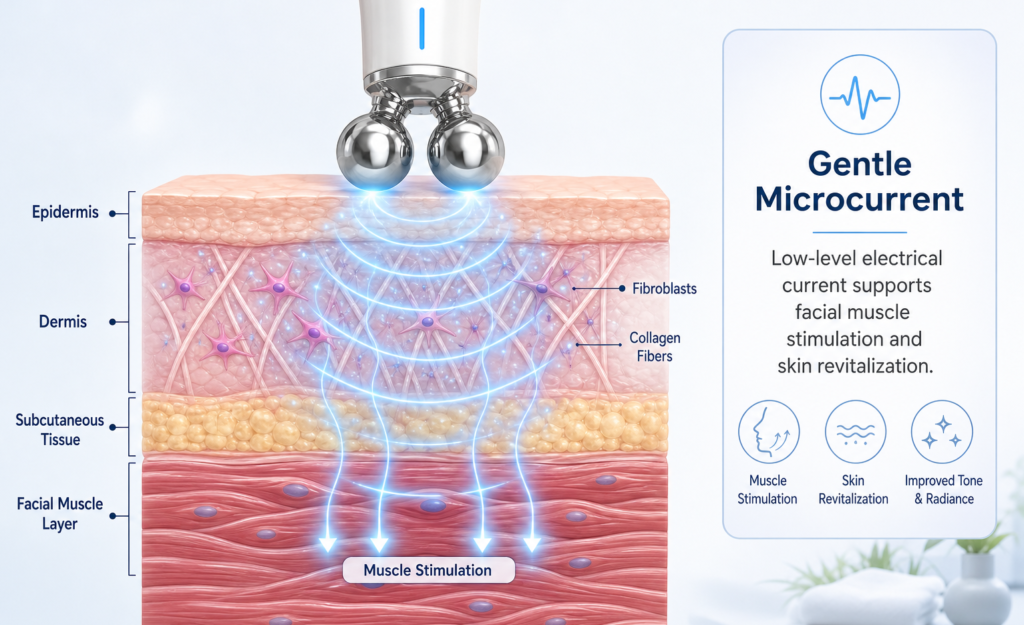
Think of it like a gentle workout for your facial muscles. Rather than forcefully contracting them the way stronger electrical devices do, microcurrent works at a subtle, sub-threshold level, gradually restoring resting tone and improving the structural support beneath the skin. Over weeks of consistent use, this shows up as a visibly more lifted, defined contour.
What Does the Research Actually Say?
The clinical evidence for microcurrent is moderate to strong — particularly for toning effects and cellular improvements. Here’s what the studies show:
- In a randomized controlled trial, the microcurrent-treated side showed statistically significant improvements in fine lines, skin texture, radiance, and overall appearance compared to the untreated side, with results appearing by week 4 of daily use.
- A clinical trial of 30 participants found wrinkle reduction of up to 18% in the forehead area after 30 sessions, with results continuing to improve a month after treatment ended.
- A 2025 home device study of 90 volunteers aged 25–65 found measurable improvements in skin aging markers across all age groups after 4 weeks of use.
- Participant satisfaction rates in multiple studies consistently exceed 70%.
The key takeaway: consistency matters more than intensity. Single sessions produce temporary improvements. The structural and cellular benefits build up over weeks of regular use.
What Microcurrent Can and Can’t Do
Let’s be honest here, because the marketing around these devices can get ambitious. Here’s a realistic breakdown:
What it can do:
- Improve facial muscle tone and lift over 4–12 weeks of consistent use
- Boost cellular ATP production, supporting collagen synthesis and repair
- Create a more defined jawline and lifted brow and cheek contour
- Improve skin texture and radiance
- Complement your existing skincare routine
What it can’t do:
- Replace surgical procedures for significant skin laxity
- Produce dramatic overnight transformation — this is a slow-build tool
- Work without consistency — skipping weeks undoes accumulated muscle tone gains
- Reverse severe or deep structural aging on its own
For most people in their 30s and 40s with mild to moderate laxity, consistent use produces genuinely noticeable results. For those in their 60s with significant sagging, it may offer subtle improvements but works best as part of a broader treatment plan.
How to Use a Microcurrent Device Correctly
Results come down to technique and consistency more than anything else. Follow these steps:
- Apply conductive gel first. Microcurrent needs a medium to travel through the skin effectively. Skip the gel and the current won’t penetrate properly.
- Work in slow, upward strokes. Direction matters. Move against gravity — glide upward and outward along the jawline, cheekbones, and brow. Hold each stroke for a few seconds in the lifted position.
- Be consistent in the first 60 days. Most devices recommend daily use for the initial 60-day phase, then 2–3 times per week to maintain.
- Track your results with photos. Changes are gradual. Take photos every two weeks in consistent lighting. It’s the most reliable way to see what’s actually happening.
Is It Worth Adding to Your Routine?
For a consistent, patient user — yes. Microcurrent occupies a unique space in the anti-aging toolkit: it’s one of the few at-home technologies that works on the muscular structure beneath the skin, not just the surface. Used alongside a solid skincare routine and good lifestyle habits, it adds a meaningful and well-evidenced layer to your overall strategy.
References
- “Investigating the Therapeutic Efficacy of Microcurrent Therapy: A Narrative Review.” https://journals.sagepub.com/doi/10.1177/20406223251361677
- “Micro-Current’s Effect on Variation of Facial Wrinkle Trend: Randomized Clinical Trial Study.” https://www.academia.edu/31457903/
- “Microcurrent Stimulation Triggers MAPK Signaling and TGF-β1 Release in Fibroblast and Osteoblast-Like Cell Lines.” https://pmc.ncbi.nlm.nih.gov/articles/PMC7564311/
- “Physiological Effects of Microcurrent and Its Application for Maximum Power Output.” https://pmc.ncbi.nlm.nih.gov/articles/PMC9941239/
- “Microcurrent Stimulation: Split-Face Randomized Controlled Trial.”
- “Evaluating the Effectiveness and Safety of Home Facial Antiaging Devices.” https://pmc.ncbi.nlm.nih.gov/articles/PMC11915080/