LED Light Therapy: Why Irradiance Determines If It Does Work
What You’ll Learn:
- What irradiance means, and why it matters as much as wavelength color
- The real irradiance gap between home-use LED masks and professional clinic ones
- How irradiance and wavelength together determine penetration depth
- Why more light isn’t always better, according to studies
- What you should check before buying an LED device
LED light therapy guides almost always leads with color. Red for wrinkles, blue for acne, near-infrared for deeper repair. That part is accurate as far as it goes. But wavelength is only one half of whether a device actually does anything. The other half, irradiance, rarely gets mentioned at all. Research suggests it may matter just as much.
Wavelength Tells You What, Not Whether
Wavelength determines what a light is theoretically capable of doing. Red light around 630 to 660 nanometers is associated with fibroblast activity and collagen signaling. Near-infrared light, roughly 700 to 950 nanometers, is associated with reaching somewhat deeper tissue. A systematic review of LED use in dermatology found consistent evidence supporting these general wavelength categories, though the review also noted that power output varied considerably across the devices studied. That detail is easy to miss, but two devices can share the exact same wavelength and still behave very differently once you turn them on.
What Irradiance and Dose Involve
Irradiance describes the amount of light energy delivered to a given area of skin, typically measured in milliwatts per square centimeter. Total dose builds on that by factoring in time. (The basic formula looks like this: dose (J/cm²) equals irradiance (mW/cm²) multiplied by exposure time in seconds, divided by 1,000.) A device with lower irradiance can still deliver a comparable dose with a longer session, and a device with higher irradiance can deliver the same dose faster. Understanding this working principle helps explain why session length recommendations vary so much between products.
The Real Gap Between Home and Professional Devices
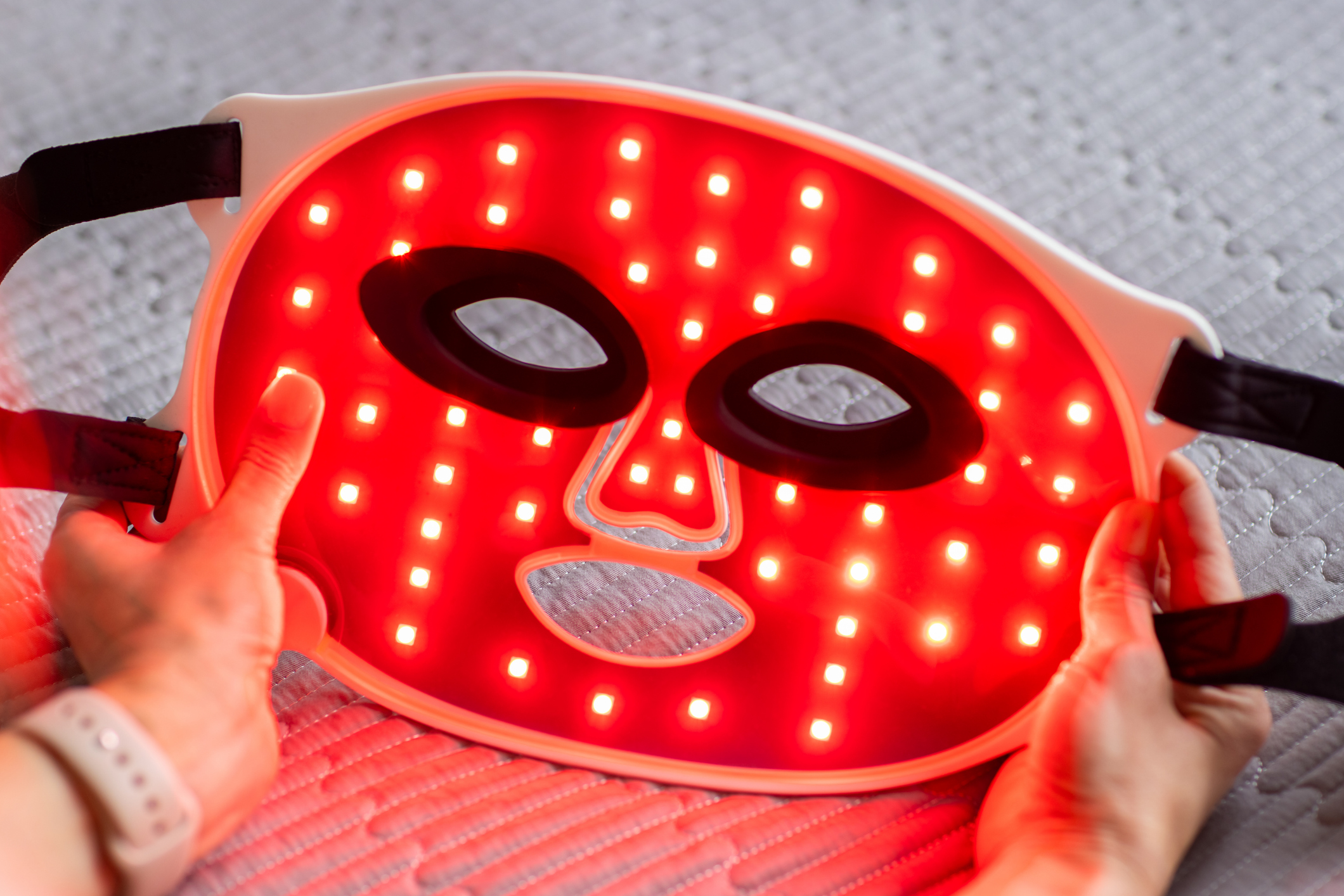
Professional clinic systems often deliver somewhere in the range of 80 to 200 mW/cm². Many consumer LED masks fall into a noticeably lower range, often somewhere between 5 and 65 mW/cm², depending on the brand and model. That gap exists for a safety reason: devices intended for unsupervised home use are typically designed with built-in safety margins, since they’re used without professional oversight. This doesn’t mean every home device is underpowered or ineffective. It does mean that the specific number matters more than most brand marketing suggests, and it’s worth checking rather than assuming.
Penetration Depth Depends on Both Wavelength and Power
Penetration depth adds another layer to this picture. A tissue-penetration research measured how far red and near-infrared light travel through skin, finding that near-infrared light generally reaches somewhat deeper than red light under comparable conditions. In principle, that makes near-infrared appealing for concerns tied to deeper tissue layers. In practice, penetration also depends on the power delivered, not wavelength alone. A near-infrared device running at very low irradiance may not necessarily reach much further than a properly powered red-light device, even though the wavelength itself has more physical potential to do so.
Is There Such a Thing as Too Weak or Too Strong?
This raises a natural question: is there a point where a device becomes too weak to matter, or too strong to help? Research on light dosing suggests the relationship between dose and effect isn’t simply “more is better.” A consistent pattern shows up across different studies. Too little light tends to produce almost no measurable benefit. A moderate range tends to support cellular activity the most effectively. Interestingly, going too high can reduce the benefit rather than boost it further. This kind of curve, where effectiveness peaks in the middle rather than climbing endlessly, shows up often enough in light-based therapy research that it’s considered a well-established pattern, not just a one-off finding. That said, the exact numbers can shift depending on tissue type, wavelength, and what specific outcome is being measured, so it’s more of a general guide than a single fixed number to hit.
Why Results Vary So Much Between Users
That nuance matters for how you interpret inconsistent results. If two people use devices with the same wavelength but meaningfully different irradiance, it’s reasonable that they could end up with different experiences, even setting aside skin type or consistency of use. Some clinical sources note that evidence for LED therapy remains mixed for several claimed uses. Inconsistent power output across the home device market is one plausible contributor to that variability, alongside factors like session frequency and different treatment goals were going in.
Why Irradiance Gets Skipped So Often
So why do device makers rarely lead with irradiance in their marketing? Wavelength is a simpler, more visual selling point. It’s easy to put a color-coded diagram on a product page, and consumers have been trained by years to look for it first. Irradiance requires slightly more explanation, and a lower number can look less impressive next to a competitor’s, even when both fall within a reasonable range for their intended use. That’s not completely deceptive, though it does mean the burden of asking the right question tends to fall on the buyer rather than the seller.
Consistency also plays a real role here. Several sources in this space suggest that sustained use over roughly eight to twelve weeks, rather than isolated sessions, tends to produce more noticeable results, regardless of which device tier you’re using. That timeline is worth keeping in mind before deciding a device “doesn’t work,” since short-term inconsistency is a common reason for disappointing results.
Irradiance Summary Table
| Device Type | Typical Irradiance | Typical Session | Best Suited For |
|---|---|---|---|
| Professional clinic system | 80-200 mW/cm² | 10-20 minutes | Faster results, in-clinic visits |
| Premium home device | 40-70 mW/cm² | 15-20 minutes | Regular home use with meaningful dose |
| Budget home mask | 5-30 mW/cm² | Often longer sessions needed | Lower-cost entry point, slower cumulative results |
What to Check Before You Buy
None of this means irradiance is the only variable worth caring about. Wavelength still determines what a device is aiming to do, and consistency of use still matters enormously for any skincare tool. But irradiance is the detail most buyers never think to check, largely because most marketing doesn’t lead with it. A red-light mask advertised heavily on its wavelength, with no mention of power output at all, isn’t a bad product. It is, however, one you have less information about than the listing implies.
A few checks can help. Look specifically for a stated irradiance figure, ideally measured at the distance you’d actually use the device, since output typically drops as distance from skin increases. If a listing only mentions wavelength and skips irradiance entirely, it’s reasonable to ask the seller directly rather than assume it’s within a comparable range to competitors. Session length matters too because a lower-irradiance device used consistently over a longer session may still deliver a satisfying result over time, even if it can’t match a higher-powered device head to head in a shorter window.
Wavelength color tells you what a device is designed to target. Irradiance, and the resulting dose, plays a large role in whether it can reach that target at all. Neither factor works well without the other, and paying attention to both gives you more sense of what any LED device, home or professional, is likely to deliver.
Frequently Asked Questions
What is irradiance in LED light therapy?
Irradiance is the amount of light energy delivered to a given area of skin, measured in milliwatts per square centimeter (mW/cm²). It determines how much power reaches your skin, separate from wavelength color.
Does LED mask power output really matter?
Research suggests it likely does — insufficient power may deliver little measurable benefit, regardless of wavelength.
What’s a good irradiance level for red light therapy?
Ranges vary by device type, but home devices commonly fall between 5 and 70 mW/cm², while professional systems often reach 80-200 mW/cm².
How long should I use an LED device to get a real result?
Session length depends on the device’s irradiance, but consistent use over roughly 8-12 weeks tends to show more reliable results than isolated sessions.
References
- “Unlocking the Power of Light on the Skin”
International Journal of Molecular Sciences, 2024 - “Light-Emitting Diodes in Dermatology: A Systematic Review”
Lasers in Surgery and Medicine, 2018 - “Measurement of the Penetration Depths of Red and Near-Infrared Light in Human Tissue”
Journal of Photochemistry and Photobiology B: Biology, 2000 - “Biphasic Dose Response in Low Level Light Therapy”
Dose-Response, 2009 - “Red Light Therapy” Cleveland Clinic, 2023