
Nanocurrent Skincare: The Next Step Beyond Microcurrent?
What You’ll Learn:
- What nanocurrent is, and how it differs from microcurrent in scale
- The bioelectric theory behind why lower current might work differently on cells
- What microcurrent research already shows, and where nanocurrent-specific research stands
- How nanocurrent compares to microcurrent and EMS
- What to keep in mind if you’re curious about trying one
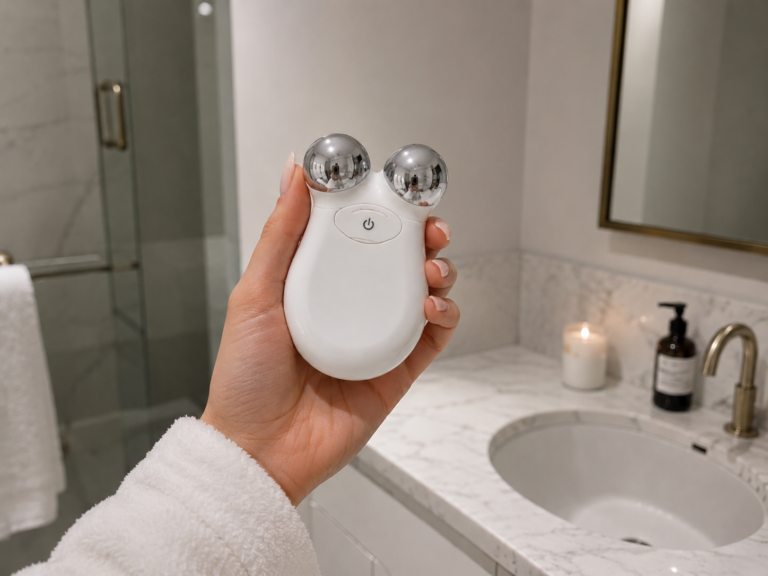
Microcurrent devices have earned a steady place in at-home skincare routines. Nanocurrent takes that same idea and scales it down dramatically. Some device makers describe it as a gentler, more refined evolution of microcurrent. The technology is new, and the research hasn’t fully caught up yet. That makes this a worthwhile category to follow closely.
A Smaller, Quieter Signal
Nanocurrent operates in the nanoampere range, while microcurrent operates in the microampere range. They have roughly a thousand-fold difference in intensity. That difference shows up clearly in how each one feels:
- Nanocurrent: typically imperceptible on the skin during use
- Microcurrent: can produce a mild tingling or pulling sensation
- The design logic: device makers frame the lower intensity as a deliberate choice, not a limitation
The premise is simple: going lower might allow the current to interact with cells in a different, more subtle way than a stronger pulse would.
The Theory Behind Going Lower
That premise connects to a broader area of research called bioelectricity. Cells communicate partly through small, natural electrical signals, and this activity plays a documented role in processes like wound healing. Skin cells generate their own electrical fields when injured, and those fields help guide repair. A recent scientific review found that weakened natural electrical signaling may be one reason certain wounds struggle to heal properly. Nanocurrent’s underlying idea builds on this concept: working at very low intensity might align more closely with these natural signals than the stronger pulses used in standard microcurrent.
Microcurrent’s Existing Research Base
Microcurrent itself already has a body of research behind it:
- Increased ATP production in treated cells, shown across several studies
- Support for collagen and elastin synthesis over time
- Modest improvement in facial muscle tone in some trials
A recent review of microcurrent research called for more standardized protocols and longer follow-up periods, since study designs vary quite a bit across the existing literature. Even with those gaps, microcurrent has a longer scientific research history than nanocurrent does right now.
Nanocurrent’s Research Timeline, So Far
Dedicated studies isolating nanocurrent’s specific effects on skin are still limited. That’s a fairly common pattern for emerging device categories, where product development tends to move faster than the research needed to validate every specific claim. Brand marketing around nanocurrent tends to describe the underlying mechanism in general terms, often without pointing to a specific published study behind the claim. That’s worth noting simply because it means the theoretical case for nanocurrent currently rests more on its connection to established bioelectric and microcurrent research than on dedicated trials of nanocurrent itself.
A Brief History of Three Related Technologies
A closer look at the two established technologies helps put nanocurrent’s position in context. Microcurrent facials became popular in clinics well before at-home devices existed, often marketed as a subtle alternative to more invasive treatments. Estheticians used handheld probes connected to a control unit, gliding them across facial muscles in specific patterns. Home devices later miniaturized that same concept into single handheld tools. EMS took a different path, borrowing from physical therapy equipment originally designed to rebuild muscle after injury, then adapting that stronger current for cosmetic use. Nanocurrent is the newest branch on this tree, and its history is measured in a handful of years rather than decades.
Nanocurrent, Microcurrent, and EMS
| Technology | Current Range | Sensation | Proposed Mechanism | Evidence Base |
|---|---|---|---|---|
| Nanocurrent | Nanoamperes | Typically imperceptible | Gentle cellular-level signaling | Emerging, limited dedicated research |
| Microcurrent | Microamperes | Mild tingling or pulling | ATP production, collagen support | Moderate, multiple supporting studies |
| EMS | Milliamperes | Visible muscle contraction | Muscle stimulation | Growing, includes controlled trials |
Nanocurrent sits at the gentlest end of this spectrum, both in sensation and in current intensity. EMS sits at the opposite end, producing visible contraction through a comparatively strong pulse. Microcurrent occupies the middle ground, and also has the most established research history of the three.
If You’re Curious About Trying One
A few practical notes are worth keeping in mind if a nanocurrent device catches your interest:
- Session guidance varies by brand: follow the specific instructions that come with your device rather than assuming it mirrors microcurrent exactly
- Treat it as a complement, not a replacement: pairing it with an existing routine keeps expectations reasonable while more research develops
- Expect a price premium: nanocurrent devices may cost more than standard microcurrent tools, partly reflecting their newer market positioning
The underlying technology builds on microcurrent, which does have research behind it, even though nanocurrent’s specific claims haven’t been independently confirmed yet. Consistency likely matters here as much as it does with any other electrical device — sporadic use of any low-level current tool is unlikely to produce noticeable change, regardless of how the specific technology gets categorized. Following the manufacturer’s suggested frequency and session length gives a device the best chance to do what it’s designed to do, while researchers continue building out the evidence around nanocurrent specifically.
The Road Ahead for Nanocurrent
A question worth asking before buying any device in this category is what problem it’s meant to solve for you. Nanocurrent is generally positioned around subtle, ongoing skin maintenance rather than dramatic, visible transformation, which is a different goal than something like EMS or in-clinic treatments aim for.
Bioelectric research as a whole is active and expanding, with growing interest in how small electrical signals influence cell behavior beyond wound healing alone. That broader momentum makes it plausible that dedicated nanocurrent studies will start appearing as the category matures, and more devices reaching the market tends to accelerate that kind of research interest too. For now, nanocurrent sits in an interesting position: built on a foundation with real supporting research, working from a biologically reasonable hypothesis, and still waiting on the specific data that would confirm exactly how much it adds beyond microcurrent alone.
Nanocurrent is worth watching rather than dismissing or fully endorsing. The technology has a sound theoretical basis, borrows credibility from a related, better-studied method, and represents one of several directions device makers are exploring as electrical skincare tools continue to diversify. Whether it turns out to outperform microcurrent is a question worth paying attention to.
References
- “Physiological Effects of Microcurrent and Its Application for Maximising Acute Responses and Chronic Adaptations to Exercise”, European Journal of Applied Physiology, 2022
- “Bioelectric Signaling: Role of Bioelectricity in Directional Cell Migration in Wound Healing”, Cold Spring Harbor Perspectives in Biology, 2022
- “Advances in Electrical Stimulation for Wound Healing”, Frontiers in Bioengineering and Biotechnology, 2025
- “Is Deficiency in the Electrical Current of Injury a Barrier to Healing in Hard-to-Heal Wounds? A Systematic Review with Implications for the TIMERS Paradigm”, Advances in Wound Care, 2025