
Biostimulators for Anti-Aging: How They Work vs. Fillers
Traditional filler works by adding volume exactly where you inject it. A newer category of injectables takes a completely different approach, triggering your own body to slowly build new collagen over the following months. That’s the core idea behind biostimulators, and it’s the next chapter in a progression of anti-aging treatments: Botox relaxes muscles, fillers restore volume, PDRN supports hydration and repair, and biostimulators aim to rebuild collagen from the inside out.
What You’ll Learn:
- What makes a biostimulator different from filler
- How Sculptra and Radiesse specifically work
- What the clinical evidence shows for each
- Realistic timelines for results
- How biostimulators compare to PDRN and traditional filler
What Is a Biostimulator, Really?
Traditional hyaluronic acid filler physically occupies space under the skin, correcting volume loss immediately and predictably. Biostimulators instead introduce a biocompatible material that triggers your body’s own fibroblasts, the cells responsible for producing collagen, to gradually build new structural support over weeks and months.
This puts biostimulators in the same philosophical category as PDRN: both are “regenerative” treatments designed to work with your biology rather than simply filling a gap. The tradeoff is patience. Results build slowly instead of appearing instantly.
Sculptra: Poly-L-Lactic Acid
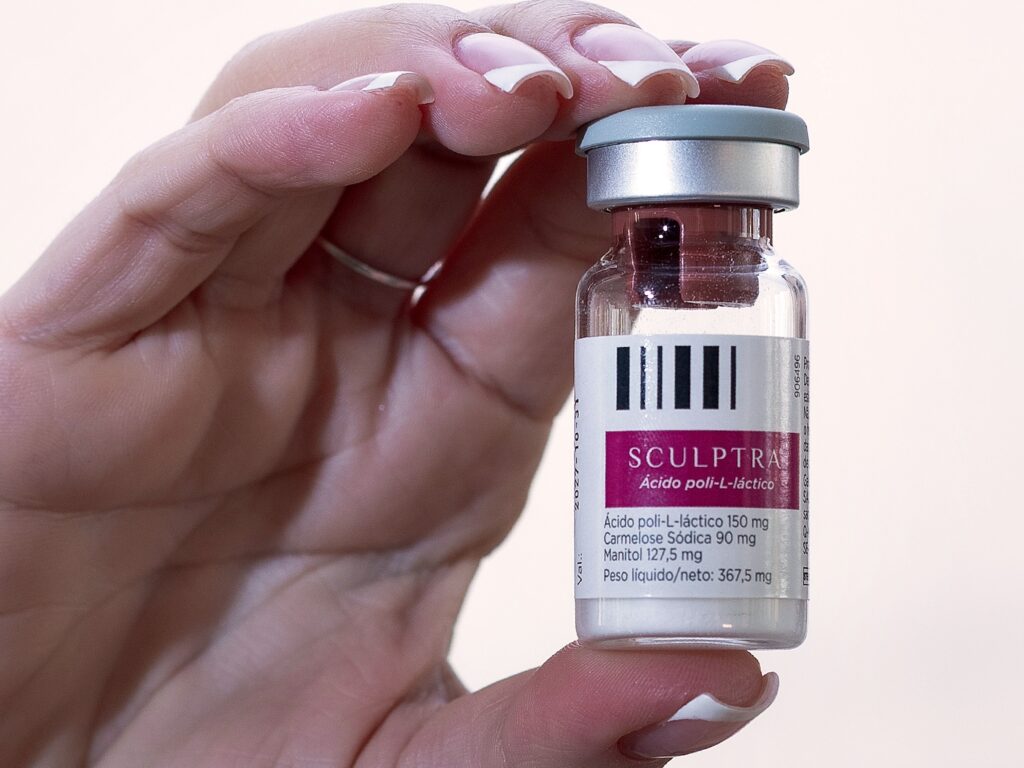
Sculptra uses poly-L-lactic acid (PLLA), a biocompatible, biodegradable synthetic polymer that has been used safely in medical applications for decades before crossing into aesthetics. Once injected, PLLA microparticles gradually break down while stimulating fibroblasts to lay down new collagen around them.
The evidence here is substantial and long-running. In a randomized, evaluator-blinded trial of 233 patients comparing Sculptra against a human-based collagen implant for nasolabial fold wrinkles, Sculptra produced significantly greater and longer-lasting improvement, with 49 percent of Sculptra patients showing no visible or barely perceptible wrinkles at 13 months post-treatment, compared to just 4 percent in the comparison group. More recent laboratory research confirms the underlying mechanism, showing measurable new collagen formation and increased fibroblast activation markers at 30 and 60 days after treatment.
Realistic timeline: initial results are subtle in the first few weeks, with visible improvement building progressively over two to three months as new collagen forms, and effects reported lasting up to 13 months or more with proper treatment spacing.
Radiesse: Calcium Hydroxyapatite
Radiesse works differently. It uses calcium hydroxyapatite (CaHA) microspheres suspended in a gel carrier, giving it a dual mechanism: the gel provides immediate volume correction on the day of treatment, while the CaHA microspheres stimulate ongoing collagen production as the gel carrier is absorbed over time.
Long-term data backs this up well. A study following 609 patients treated with CaHA across multiple facial areas found 89 percent satisfaction at 6 months and 74 percent at 12 to 24 months, with minimal adverse events. A separate three-year follow-up study found no delayed-onset or long-term adverse events, with some patients still showing sustained cosmetic improvement at the 30-month mark. A more recent randomized trial of a newer Radiesse formulation reported responder rates as high as 78.7 percent at 24 weeks post-treatment, with the majority of patients rating themselves very much improved.
This dual-action profile makes Radiesse behave more like a hybrid, part immediate filler, part gradual collagen stimulator, rather than the purely slow-build approach of Sculptra.
Biostimulators vs. Traditional Filler vs. PDRN
| Traditional HA Filler | Biostimulators (Sculptra/Radiesse) | PDRN | |
|---|---|---|---|
| Mechanism | Physically adds volume | Triggers new collagen production over time | Supports tissue repair and hydration signaling |
| Onset of results | Immediate | Gradual, over weeks to months | Gradual, over several sessions |
| Longevity | 6 to 18 months | Up to 13+ months, sometimes longer | Shorter, typically requires maintenance courses |
| Best suited for | Volume loss, deep folds | Overall facial thinning, gradual natural-looking rebuild | Skin quality, texture, dehydration |
Can biostimulators replace filler entirely? Not really. They solve a different problem. Filler is the right tool for a specific fold or deflated area that needs immediate correction. Biostimulators are better suited to broader, gradual facial thinning where a slower, more natural-looking rebuild is the goal.
What Treatment Actually Involves
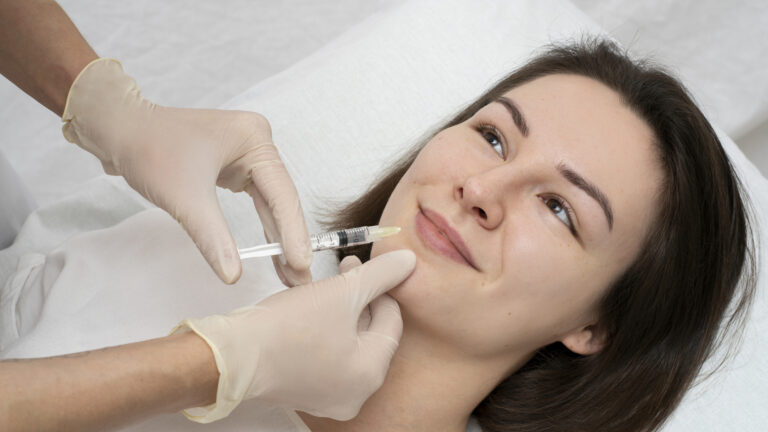
Biostimulator treatment is typically delivered as a series, not a single visit. Sculptra protocols often involve two to four sessions spaced roughly three weeks apart, while Radiesse can sometimes achieve target correction with fewer sessions given its immediate-volume component.
- Mild swelling, redness, or bruising at injection sites is common and temporary
- Results should not be judged at the two-week mark, since the collagen-building effect takes months to fully develop
- Touch-up or maintenance treatments are often recommended annually to sustain results
This is fundamentally a patience-required treatment, not an instant-gratification one. Many providers frame the first session almost as a starting point rather than a finished result, since the visible change on day one is intentionally minimal. That framing matters for expectation-setting: someone comparing before-and-after photos of filler and biostimulators will notice the filler patient looks different immediately, while the biostimulator patient looks nearly the same on day one and gradually different by month three.
Pairing With Other Approaches
Biostimulators are increasingly used as part of a broader, combined approach rather than a standalone treatment. Some providers pair biostimulator sessions with collagen-supporting devices like microneedling or radiofrequency (RF), on the theory that stimulating the skin through multiple mechanisms at once may support a stronger overall collagen response than either approach alone.
The logic makes sense on a biological level:
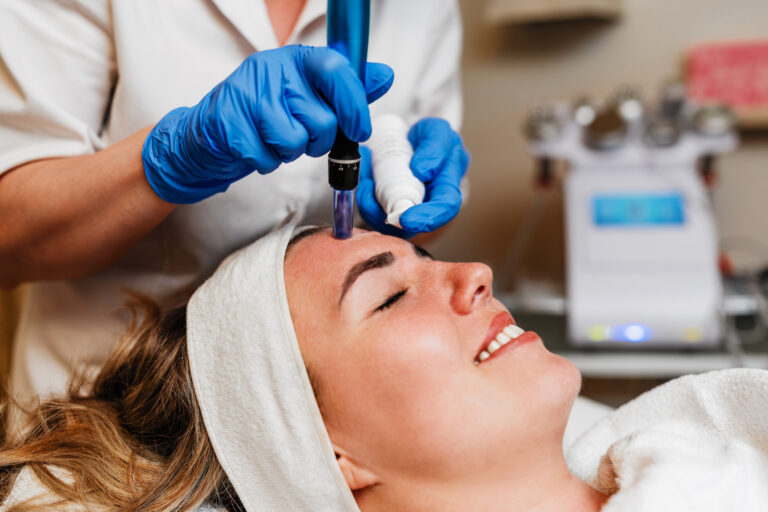
- Microneedling creates controlled micro-injuries that trigger the skin’s own wound-healing response.
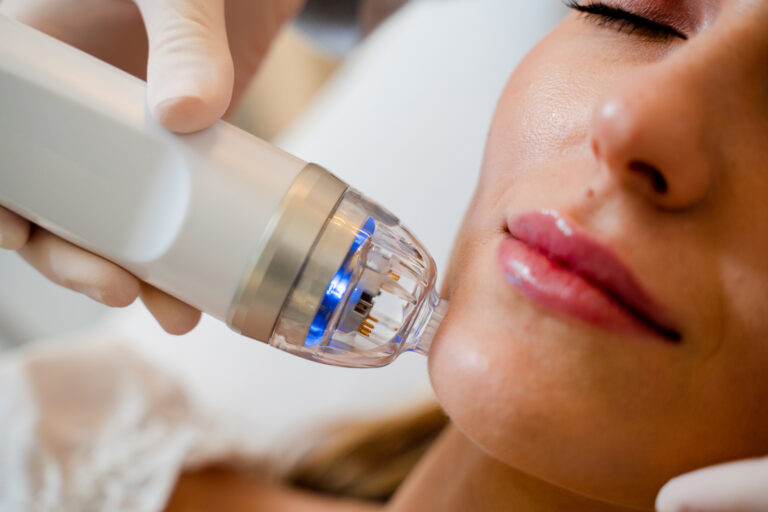
- RF devices use heat energy to encourage collagen remodeling in the deeper dermis.
- Layering a biostimulator’s fibroblast-triggering effect on top of that additional stimulation is a commonly discussed protocol in aesthetic practice.
For some people, the injectable alone is enough, and adding more treatments simply adds cost and downtime without a clear additional benefit. But if you’re already using an at-home RF device or considering in-office microneedling as part of your routine, it’s worth discussing timing with your provider, since spacing these treatments correctly around a biostimulator session may matter more than doing them simultaneously. A provider can advise whether your specific device or microneedling schedule should happen before, after, or independent of a biostimulator series.
Who It’s Best For
Biostimulators tend to make the most sense for:
- Gradual, overall facial volume loss rather than one specific deep fold
- People who want a natural-looking buildup rather than an immediately visible change
- Those comfortable committing to a multi-session treatment plan and the patience it requires
- Anyone already investing in a broader skin-quality routine who wants a collagen-focused injectable to complement it
People who need immediate correction for a specific area, or who prefer a single-session result, are usually better matched to traditional filler or, for skin-quality concerns specifically, PDRN.
Conclusion
Biostimulators represent a different philosophy from traditional filler: build rather than fill, gradual rather than instant. The clinical evidence behind both Sculptra and Radiesse is substantial and long-running, but the tradeoff is real patience, since meaningful results take months, not days, to fully appear.
References
- “Investigating the Effect of Biomaterials Such as Poly-(l-Lactic Acid) Particles on Collagen Synthesis In Vitro: Method Is Matter.” Journal of functional biomaterials vol. 11,3 51. 24 Jul. 2020
- “A randomized study of the efficacy and safety of injectable poly-L-lactic acid versus human-based collagen implant in the treatment of nasolabial fold wrinkles.” Journal of the American Academy of Dermatology, Volume 62, Issue 3,2010
- “Impact of Poly-L-Lactic Acid Reconstitution on the Neocollagenesis Profile” Aesthetic plastic surgery vol. 49,18 (2025)
- “Long-Term Duration and Safety of Radiesse (+) for the Correction of Volume Deficit” Journal of cosmetic dermatology vol. 23,10 (2024)
- “Calcium Hydroxylapatite (Radiesse) for Treatment of Nasolabial Folds” Aesthetic surgery journal vol. 30,2 (2010)
- “Evaluation of a Calcium Hydroxylapatite-Based Implant (Radiesse) for Facial Soft-Tissue Augmentation” Plastic and reconstructive surgery vol. 118,3 Suppl (2006)
- “Collagen Stimulators in Body Applications: A Review Focused on Poly-L-Lactic Acid” Clinical, cosmetic and investigational dermatology vol. 15 997-1019. 21 Jun. 2022