
Why At-Home Lasers Could Be the Next Big Shift in Anti-Aging
What You’ll Learn:
- Why laser-based anti-aging treatment is moving beyond the clinic
- How home lasers trade intensity for repetition and convenience
- Why devices labeled “laser” can work in very different ways
- What current home-laser brands reveal about where this category is heading
- Why home devices are more likely to complement professional care than replace it
Cosmetic laser treatment has long belonged to the clinic: a consultation, a relatively intensive procedure, some recovery time, and a wait for results to unfold. That model is starting to shift.
A growing set of consumer devices is bringing selected forms of laser-based skin treatment into the home. They are not “mini” clinic lasers, but lower-intensity tools built for repeated, unsupervised use. It signals a broader shift in how people think about anti-aging: less as an occasional correction, more as something managed continuously, like skincare already is.
Anti-Aging Is Becoming Continuous
Traditional laser treatment is episodic. You notice wrinkles, sun damage, or textural change, visit a clinic, and receive a procedure designed to produce a meaningful result in a limited number of sessions.
At-home devices propose a different model: smaller interventions, repeated often. This mirrors how skincare already works. Sunscreen protects daily. Retinoids act gradually. LED masks and microcurrent tools have already taught consumers to expect progress from consistency. Home lasers extend that logic into a category that once felt strictly clinical.
The trade-off can be summarized simply: professional treatment concentrates energy into fewer, stronger sessions, while home treatment spreads lower-intensity energy across many. They serve different needs. A clinic offers assessment, adjustable settings, and stronger correction. A home device offers privacy and a routine people can sustain, often starting before visible aging becomes significant, or maintaining results between professional treatments.
This shift from correction toward maintenance is arguably the most important part of the trend.
Why Home Laser Appeals Now
Several forces are converging to make this the moment for home laser adoption.
Convenience has become part of the treatment itself. A home device removes the friction of appointments. No travel, no waiting room, no rearranged schedule. Industry coverage of at-home beauty technology points to convenience, cost, and preventive-aging interest as key motivations behind the category’s growth. But convenience shouldn’t be mistaken for less commitment: home lasers typically trade a handful of clinic visits for weeks of smaller sessions. The time cost has been redistributed.
Consumers want more control. Deciding when to treat and how to fit it around a routine appeals to people who want gradual change without scheduling a visible cosmetic procedure. It also reflects a broader move toward personalized, self-directed skincare.
Topical skincare alone doesn’t satisfy the demand for deeper action. Creams and serums support the skin barrier, deliver antioxidants, and influence turnover, but they can’t reproduce what controlled energy does beneath the surface. Laser carries a strong association with precision and collagen remodeling, which is exactly why the idea of a home laser is so compelling, even though a consumer device shouldn’t be assumed to match a professional system’s output.
The at-home device category has already earned consumer trust. LED masks, microcurrent, and radiofrequency tools have made skincare hardware a familiar part of daily routines, not a novelty. For consumers already using light or electrical stimulation at home, a laser feels like the next natural step in an established routine.
“Laser” No Longer Means One Thing
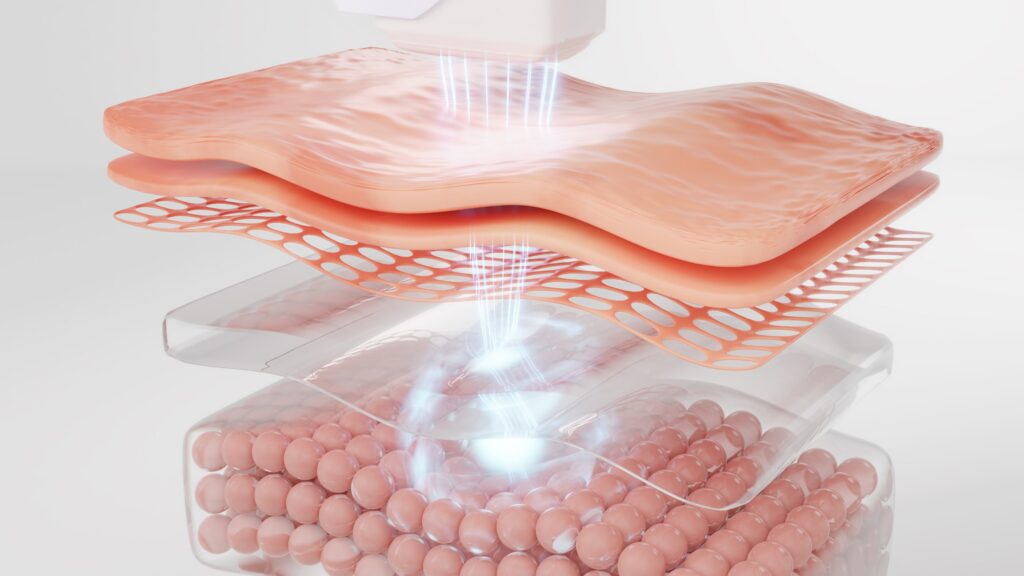
The word laser makes these devices sound more alike than they are. Two products can share the same anti-aging goal, smoother-looking lines, for instance, while differing in wavelength, delivery pattern, and biological mechanism.
| Home-laser approach | How it broadly works | What it prioritizes |
|---|---|---|
| Non-ablative fractional laser | Treats microscopic zones, leaving surrounding skin untouched | Controlled remodeling with lower recovery burden |
| Non-fractional thermal laser | Delivers heat more uniformly across a spot | Repeatability and minimal disruption |
| Low-level laser | Uses light for photobiomodulation, not thermal injury | Frequent use without heat-based resurfacing |
| Precision applicator | Targets small areas like crow’s feet | Easier self-treatment, controlled exposure |
Ablative and non-ablative describe whether tissue is removed or simply heated. Fractional and non-fractional describe how that energy is distributed across the treatment area (you can read more in our post about laser types). Home devices are usually non-ablative and fractional, or non-ablative and non-fractional. Professional ablative treatments remove outer tissue and can produce more dramatic results with greater downtime. Non-ablative treatments heat tissue without removing it and typically require multiple sessions. Furthermore, wavelength alone doesn’t determine what a device does. Target chromophore, total energy, pulse duration, coverage area, and frequency of use also shape the outcome.
What Brands Reveal About the Trend
Current home-laser brands aren’t converging on one design. They’re testing their competing technologies and philosophies for the same underlying anti-aging goal.
NIRA’s devices use 1450 nm non-ablative, non-fractional laser technology to deliver controlled heat, with smaller tips for targeted areas and larger treatment tips for broader coverage. Daily use is central to the brand’s approach. Tria FRX uses 1440 nm non-ablative fractional technology, delivering energy in microscopic treatment zones rather than uniformly across each spot. MimiSilk’s Iris also uses non-ablative fractional delivery at 1450 nm, with a scanning method and fixed weekly routine for treating facial areas. LYMA Laser takes a non-thermal approach, using an 808 nm low-level laser for photobiomodulation rather than controlled heating. These are distinct treatment methods, and their technical specifications alone don’t show which produces better results.
Together they reveal what the industry is actually solving for: shorter sessions that become habits, minimal downtime, tightly controlled energy delivery, and schedules that consumers can easily follow without clinical supervision. The brands disagree on mechanism but share the same underlying belief: meaningful anti-aging doesn’t require an appointment. The product being sold isn’t just a handheld laser to use at home. It’s a laser routine.
Repetition Replaces Intensity
Bringing laser treatment home depends on compromise. A clinic can adjust depth and intensity to the person and the concern. Stronger settings can create a bigger remodeling response, at the cost of more downtime. Home devices can’t offer that range. To make unsupervised use safe, they rely on lower output, standardized settings, and gradual routines.
That reshapes what results should look like. In a study of a home-use non-ablative fractional laser, 124 people treated the skin around their eyes daily for several weeks, then cut back to twice a week to maintain results. When doctors reviewed before-and-after photos, 90% showed visible improvement in wrinkles after the first phase, and 79% still showed improvement months later. The most common side effect was temporary redness after treatment. However, this is a promising result for this one device, not proof that every home laser works the same way.
What Home Lasers Can Change
At-home lasers make sense when your expectations match their design, which translates into gradual care for mild fine lines, early textural change, or dullness instead of dramatic resurfacing. That makes home laser a natural fit for prevention-minded users who want something beyond topicals but don’t need, or want, a clinical procedure.
They may also fill the space between clinic visits, supporting maintenance after a more intensive professional treatment, though this complementary role hasn’t been officially established in most practices.
The limits remain real. Professional fractional laser treatment is still better suited to deep wrinkles, meaningful laxity, significant scarring, and complex pigmentation. Non-ablative resurfacing typically produces subtler results and may need multiple sessions, while ablative procedures produce more substantial change with longer recovery. And laser resurfacing cannot correct sagging skin. Home devices sit even further toward the gradual end of that spectrum.
The Future Is Likely Hybrid
At-home lasers won’t eliminate professional treatments. They’re more likely to add a layer to a system that already exists for most people who have an anti-aging routine: daily skincare for baseline protection, home devices for consistent low-intensity maintenance, and clinical procedures for diagnosis and stronger correction.
The most valuable innovation ahead probably isn’t more powerful home lasers. They could be smarter and lower-intensity. That could mean sensors that detect skin contact and automatically adjust the energy delivered, treatment plans that adapt based on how a person’s skin actually responds over time, broader testing across different skin tones, and clearer information about what each device actually does. Dermatologists may eventually treat home devices like certain skincare products: not a replacement for professional treatment, but a tool that helps patients maintain results between visits.
A New Middle Ground
At-home lasers matter less because they replicate a clinic visit and more because they fill the space between topical skincare and professional treatment—trading intensity for consistency, and asking users to trade speed for patience.
Whether the category becomes a lasting part of anti-aging routines will depend on evidence, not marketing. Brands that back their devices with transparent specifications and device-specific research will earn more trust than those relying on before-and-after photos alone. The more realistic future isn’t a clinic-grade laser doing clinic-grade work at home—it’s a three-part system: daily skincare for baseline protection, home devices for ongoing maintenance, and professional treatment for the corrections that still require a trained hand.